Episode Transcript
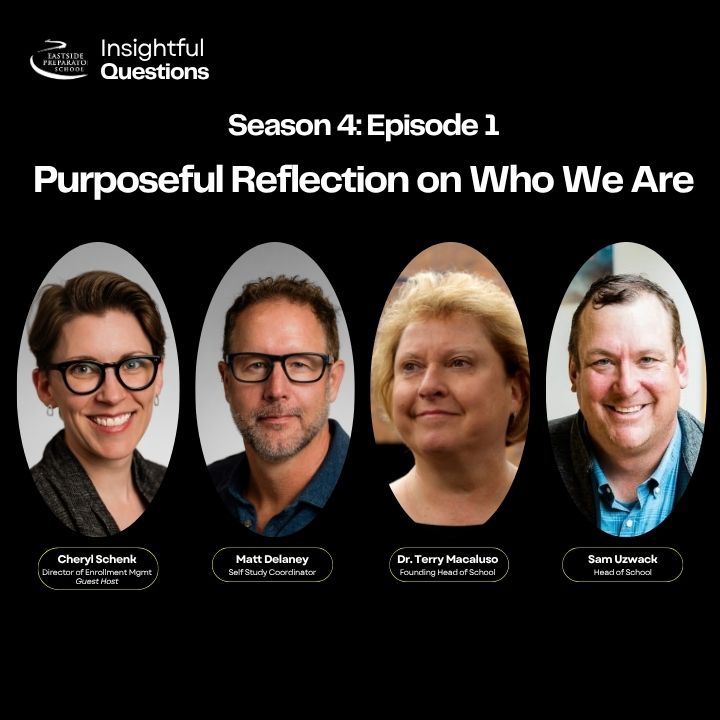
[00:00:00] Speaker A: Welcome to EPS Insightful Questions, a monthly podcast produced by Eastside Prep. I'm Sam Uswak, head of school. On our fourth season, we're exploring the theme think Critically Purposeful Reflection. In each episode, we'll sit down with members of the EPS community as they reflect with purpose on their practice, their experiences in and beyond the classroom, and the questions that shape how we learn, teach, and grow together. We hope these conversations invite a little reflection of your own. So let's get started.
This month, our annual theme takes concrete form. This is the year Eastside Prep formally reflects on itself through a process called an accreditation Self study. If that phrase is new to you, this episode was made with you in mind. Since I'll be one of the guests answering questions today, it seemed only right that someone else ask them. So it's my pleasure to hand the microphone to our guest host, Director of Enrollment Management, Cheryl Schenck.
[00:00:57] Speaker B: Thank you, Sam.
[00:00:58] Speaker A: You bet.
[00:00:59] Speaker B: Today we are talking about what accreditation is, who conducts it, and why it matters to everyone in this community. So joining me are three people who know this process from every angle. Sam Usuak, our current head of school, leading a self study for the very first time. Might I add Terry Macaluso, Eastside Prep's founding head of school, who has been through two EPS accreditation visits and probably even more in her illustrious career. And Matt Delaney, our self study coordinator, who was also involved in. Very involved in the last EPS reaccreditation.
Welcome, everyone. One ground rule before we begin is that we are going to. This ground rule is important. We are going to use plain language only, so we're going to avoid accreditation jargon and acronyms and start with the basics. So with that in one sentence, no jargon.
Matt Delaney. What is accreditation? Get us started.
[00:02:02] Speaker C: Accreditation is a moment of crystallization and reflection on what we do, how we do it, and why we do it.
[00:02:13] Speaker B: Terry, what is accreditation?
[00:02:14] Speaker D: Accreditation is a little bit of an irony. Independent schools are supposed to be independent, and they certainly are. But there also has to be some kind of measure, some way of gauging whether or not the school is doing what it says it's doing.
[00:02:31] Speaker B: Sam, what would you add? What is accreditation?
[00:02:33] Speaker A: Accreditation is an opportunity. It's an opportunity for us to take a very deep, intentional dive into what we are doing and to hear from folks, are we actually doing that?
And also because we've all been swimming in these waters for so long, to get an outside perspective about how we're doing and where we're going.
[00:02:55] Speaker B: So again, you are leading the school through this process for the first time as head of school, what do you think this, what did you think that this year would involve? And what has already surprised you?
[00:03:07] Speaker A: To be honest, what's already surprised me is that there's genuine excitement about the process we held for our opening meetings with our faculty and staff.
Matt put together a presentation. Cause we want everyone to know how it works and how people will be involved. And as we surveyed, you know, that whole week long experience, that presentation popped as something that not only was interesting, but actually got folks fired up a little bit in terms of diving into the process and really thinking about our school.
[00:03:35] Speaker B: Terry, as we mentioned earlier, you've already been through two EPS accreditations. That's not even career or lifetime accreditation processes that you've been through. Walk us through. The visiting team arrives.
What would they actually see and do? Let's give people a sense of what the machinations of accreditation are.
[00:03:52] Speaker D: A team of sometimes as many as a dozen and sometimes as few as half a dozen arrive on campus and are new to the place, new to the facilities, new to the philosophy, new to the people. There's a level of nervousness and anxiety that everyone experiences because of course when someone is evaluating you, you want to look good and everyone ultimately does, but they worry at the beginning that they might not. The visiting team also understands that it has a task and that is to assess a school that it doesn't really know that's actually intentional. Because the school's description of itself, its portrait of itself, is the measure by which it is then evaluated. So it's a self reflective process. As has been obvious so far. It is making ourselves available to and open to people who are learning about us for the very first time. In fact, it is a huge challenge to be able to get oneself out of the atmosphere enough to be able to reflect a more objective perspective.
[00:04:52] Speaker B: This visiting team of folks, they are really coming at this from that place of interested outsider. They don't have familiarity with what's happening in Eastside Prep, but they're looking around, taking that self study document and trying to make sense and see if there's fidelity and coherence.
[00:05:08] Speaker A: A number of us at this school have served on visiting teams. There's an excitement and a nervousness when you arrive at the school. You really want to do a good job, you want to be positive, but you also want to provide constructive feedback and not shy away if there's any challenges. The whole experience is one full of energy that way.
[00:05:26] Speaker B: So who are these? You mentioned that Eastside Prep Community members have participated in these visits at other schools. So who are these accreditors? Matt, who are the accreditors and who gave them authority?
[00:05:38] Speaker C: Well, as a member of nais, which is the national association of Independent Schools, we are required to be accredited on approximately eight year cycles, and that's by an independent agency, usually regional. And NWAI is our regional association that we're part of. Terry alluded to this a little bit before. As we walk into this, we're not interacting with an external accreditor. It really is a peer review model. And so as we invite that visiting team in, there is a power to us collaborating with that team for our own improvement. And I actually think the teams walk out and go back to their schools. I know I did when I was on a visit and think about what we saw and how what we saw might contribute to us improving.
[00:06:22] Speaker B: So what I'm hearing is we are the accreditors, but not for our own process. We're going to benefit from having this outside interested, outsider perspective on what we do here at eps, but that we are part of the group through the Northwest association of Independent Schools that provides accreditation processes and reaccreditation processes for any of the member schools of the organization.
[00:06:45] Speaker C: Exactly.
[00:06:46] Speaker D: Okay.
[00:06:46] Speaker B: When we think about the outcomes of this process and what it leads to. You mentioned this eight year cycle.
What happens if it doesn't go well? When can a school fail? What are the kind of stakes of this? Terry, I'm wondering, you know, you led us through Eastside Prep's initial accreditation process, that kind of first effort. What would you say is the sense of worry that folks might have about the visit? What are the real stakes?
[00:07:18] Speaker D: The. The stakes involved in a first accreditation feel much higher than they do when a school has been traditionally accredited. And that is because there's no there there. There's nothing that we've got no established statement or design or structure that allows us to point and say that's what we're doing. So in the first year that we did this and we had to have all of our grades in place, we had to be 5 through 12 enrolled.
That in that first year we had to present the whole thing and we could make no assumptions about whether or not people thought this was a credible effort.
What was also hanging in the balance for that first accreditation was the school's potential future.
Had we not succeeded in that accreditation process, I doubt very much that we'd be doing this podcast today.
[00:08:06] Speaker A: Terry. I had joined the school in the fall that the first visiting team arrived. I Recall some narrative about it's the rare school that is fully accredited in the first.
[00:08:17] Speaker D: The fact is that that is the case, and that's what I knew as we were going into it. So there's a huge amount riding on that first round. The staff put together an extraordinary study. They represented the school brilliantly, and we were among the very few schools who, in the initial attempt, were fully accredited.
[00:08:34] Speaker B: So having arrived here myself in the fall of 2018, when we were going through that second visit, Terri, what was the difference in the feeling for you as a head of school in that second visit versus the initial accreditation effort?
[00:08:48] Speaker D: The initial accreditation effort felt a little bit like the family around the dinner table. It was a very small population.
Everyone knew everything. I was 100% confident that everyone would be able to represent the school absolutely accurately, fully recognizable. The second time around, we had doubled in size, maybe even more than that. And I didn't have the same reach that I had had originally. I didn't have face to face conversations with everybody teaching every day. That was true in the first few years, but by the time we were coming on for our second accreditation, there was much more distance between me and the rest of the community. And that's always the case.
The head's job is to be able to maintain the sort of outside face of the institution at the same time. That same face has to be fully an opportunity for a head, in my case, to be able to say to another head, you're doing an amazing job. Now let's talk about how you're doing that. So it's a. It's a positive spirit lifter. It's a chance for expression of appreciation, and it's also a great chance for anyone on a team to learn much more than they actually bring back.
[00:10:01] Speaker B: With that role of the head, Terri, that you talked about transitioning from, we are around the family dinner table, too. We've grown. And therefore these individual conversations aren't happening all the time. Sam, I'm curious for you thinking about the process of the school studying itself first, that now we've grown beyond even the size that we were in 2018.
So talk to me about why the school studies itself first. Why does that happen before the team visits? Couldn't the team visit first and generate a bunch of questions, and then we could reflect on those questions purposefully? What is with the order of this process?
[00:10:38] Speaker A: This is for us. I like to think of accreditation as an exercise and an experience in thinking about who we are and planning for the future and the natural outcome of that should be, you get re accredited. And so we study ourselves first because it allows us to see how we've done since the last accreditation to celebrate progress. It allows us to build a process that is very, very inclusive. Our process will be measured by all of the constituencies sense of involvement and engagement and participation. And Matt really keeps a very sharp eye on this. I had some ideas as we were in our initial planning sessions, using some instruments that we've given in the past as part of this, of trying to shrink certain elements of the process, keeping an eye on time and other people's time. But Matt reminded me that this is a moment where the whole community is reflecting on what Eastside Prep is is and who Eastside Prep is and where Eastside Prep is going. So that's why we do all that work first. And then the visiting team has this herculean task of showing up for three days after having read the self study and essentially verifying that what we say we're doing is in fact the case.
[00:11:49] Speaker B: It's almost like grading your own test.
What keeps the self study honest? How do we stay honest instead of just stacking the deck in our favor
[00:11:59] Speaker A: as we assemble that because of Terry's efforts from the beginning and because of our progression through those accreditations and throughout the years, we are in excellent shape. So for this to be meaningful, it's not worth glossing over the challenges we're engaged with because of the challenges we're engaged with. If I'm working with a student and I say, hey, grade your own test, and they're like, yeah, I can give myself an A, but they haven't actually learned anything, that's not a very good job of grading your own test. So in some ways, we're actually modeling what we expect from kids.
[00:12:28] Speaker D: We.
[00:12:29] Speaker A: We're gonna think about ourselves deeply and we're not gonna shy away from areas where we need to improve. Because what happens is the feedback we get from the visiting team and what we've learned and discerned over the process. We're actually. Next year we're gonna be in the process of writing our next set of strategic priorities.
[00:12:49] Speaker B: Got it?
[00:12:49] Speaker A: For the school, the timing is actually really wonderful in terms of being able to port over learnings from this process into. Into the very next long term process that our school engages in.
[00:13:01] Speaker B: So when we think about those learnings from the previous process, I'm curious, Matt, can you highlight some examples for us or maybe one noteworthy example about what was something that came out of that 2018 visiting team and self study experience? That you can see that Eastside Prep has worked on since that time.
[00:13:21] Speaker C: Well, when you talk about came out of the process, I think it brings me to something. I think we do really well at Eastside Prep. Listen. So important during this process is gathering feedback and gathering information from the community. And that also means thinking about questions that perhaps we haven't heard in that forum or before. And so whether we have the community doing surveys or we're working with our faculty and staff in different listening groups on professional development days, those are opportunities for us to hear what the community is thinking and what the community wants to know and understand. A couple of concrete examples come to mind. I'll just use one. We had some questions come up about how we approach financial aid. And not just how we approach financial aid, but how do we educate families about financial aid and how it works at Eastside Prep? And as we took in that question, we had an opportunity to think about what our processes were and how we might improve them. The outcome of that is part of our approach right now in admissions as we think about, okay, what kind of video content could we put together for families so they would understand the process better? Could we come up with some case studies so that families could look at different circumstances and better understand their circumstance through that lens? Beyond that, it's about people and support. So in admissions, we have more people on campus now who can answer questions about financial aid and how it works. Financial aid is an incredibly important tool at our school. And because of that last accreditation process, we were able to shine a little brighter light on it and think a little bit more deeply again about what we do, how we do it, and why we do it?
[00:15:09] Speaker B: I appreciate that example you talked about listening, Delaney. What happens to what the community says when you think about those mechanisms for listening, for example, a listening group around the accreditation process or anything along the way to the final report. Can you trace that path for us? Because we're taking this huge body of work on in approaching the self study this year. How do we go from that discipline of listening to that final report? What's that workflow or that arc going to be?
[00:15:42] Speaker C: The process is inviting feedback, feedback and then receiving it within the self study. We're going to take on a section that says the self study process. So we're going to talk about how we actually do it and what the results of it were. Beyond that, we take feedback from the entire community and think about how it applies to the remainder of the self study.
[00:16:04] Speaker B: So if somebody listening wants their voice in this year's, self study. Sam, what would you advise for parents and guardians?
[00:16:11] Speaker A: We will be sending out a survey in the first week of October that is designed to gather feedback for our self study.
[00:16:17] Speaker B: Terri, what would you say you would recommend for community members that are interested in this process, want to contribute a voice? Sharing as a mode of participation, that's
[00:16:28] Speaker D: one of the things that is most powerful in this process. Independent schools, and this is the reason I've spent my life working in them, are places where ideas are more important than pretty much anything else. People work together, they think together, they create together. And what they come up with is whatever they come up with. What kind of objective measure can we use now to assess whether or not that is a good thing? Is the system that we use for teaching math in grade nine good? Are we teaching an American history curriculum that is appropriate? Well, what does appropriate mean? So it's a matter of conversation after conversation after conversation, and it's the only real opportunity that schools like ours have to have someone show up and say, what is this deal you got with them?
And realize that that question is one that we've had for five years and we've never been able to break ourselves through it. So it's an amazing opportunity for somebody else's eyes to look at the work we've done and to say to us, you might try a, B or C, and it gives us spans are rising dramatically and it gives the school sort of opportunity for substantial growth.
[00:17:35] Speaker B: To that end, Terry, what was something that you believed before your first visit that actually turned out to be completely wrong or.
Or a false belief that you had either about the school or about the program? Something that we were doing? Does anything come to mind as discovery that happened for you along that journey?
[00:17:54] Speaker D: One of the interesting things about this process is that only a portion of it is about the program. A substantial amount of it is about the logistics of operating a business.
So everything from insurance to budgeting to human resources, every dimension of the operation of the business is assessed. And the first time out, it's a little bit traumatizing to know that we have no money. We started with no money and we still have no money. So we're being consistent. But the fact is that our resources were so limited that one wonders whether or not we're actually going to be able to achieve what we've said we're going to achieve. I was so worried about that and so stunned. There was not a single problem on the logistics side. There weren't problems anywhere, really. We came through that with no Resources still able to run a perfectly wonderful school. Obviously the school was going to have a future because up until that moment we didn't know whether or not we were going to be accredited. Had we not been, I'm not sure we would have been able to find people to take a risk.
[00:18:50] Speaker B: Terry, in your legacy as our founding head of school and alongside all of the families who have believed in EPS over the years, in part because it was an accredited school, after that initial self study effort, you really have helped EPS to be established as that resource filled place from which we can operate now and engage in the process differently. Matt, as you are thinking about what this year's self study is going to look like as a form of continuous improvement rather than establishing we're a real place with real people and a few dollars to show for it, what would you say in terms of of the resourced nature of going into this self study and this idea of continuous improvement that folks should know about that form.
[00:19:33] Speaker C: A reflective life is a life worth living and I think that very much applies to schools. So the first time we went through an accreditation process it was is our ship seaworthy? Can it stay afloat? As we move through the life of the school and we continue reflecting on what we are and how we might improve, we have an opportunity to just keep getting better. So if we're gonna take an entire community and an entire school through this process, we want it to be worth it. We wanna come out of the other side saying that was a vital experience. We know who we are better than we did when we started. And now let's talk about what we wanna do next year and let's talk about what do we wanna do five and what do we wanna do 10 years from now?
[00:20:16] Speaker B: Awesome. We're excited about this journey and over the course of the year the school's gonna reach out to different members of our community in ways that will suit each moment best. Use that tool that's right for the occasion. So when that invitation comes, whether it's joining a listening group or responding to that survey that you mentioned, Sam, or attending a meeting, we really hope that you as EPS community members will take part and keep an eye out for that companion pace in insight in our EPS weekly email to participate in that self study survey.
[00:20:48] Speaker A: Sam, what we hear from this community will help shape the self study. So when your moment comes, we hope you'll share your perspective. Thank you for listening to insightful questions. We'll see you next month for more insights. Be sure to check out the EPS weekly news every Friday,
[00:21:14] Speaker C: Sam.