Episode Transcript
[00:00:02] Speaker A: Welcome to Insightful Questions, Eastside Prep's monthly podcast. In our third season, we will feature conversations with members of the EPS community, all centered around this year's theme, Responsible Action. Care through Clarity. I'm your host, Sam Uzwak.
Today's episode focuses on digital responsibility in a transparent world. We'll explore what it means to make thoughtful choices in a space where everything can be seen, saved, or shared.
From texting and posting to using AI tools in everyday life.
We'll look at how clarity, care, and intention shape the way we show up online.
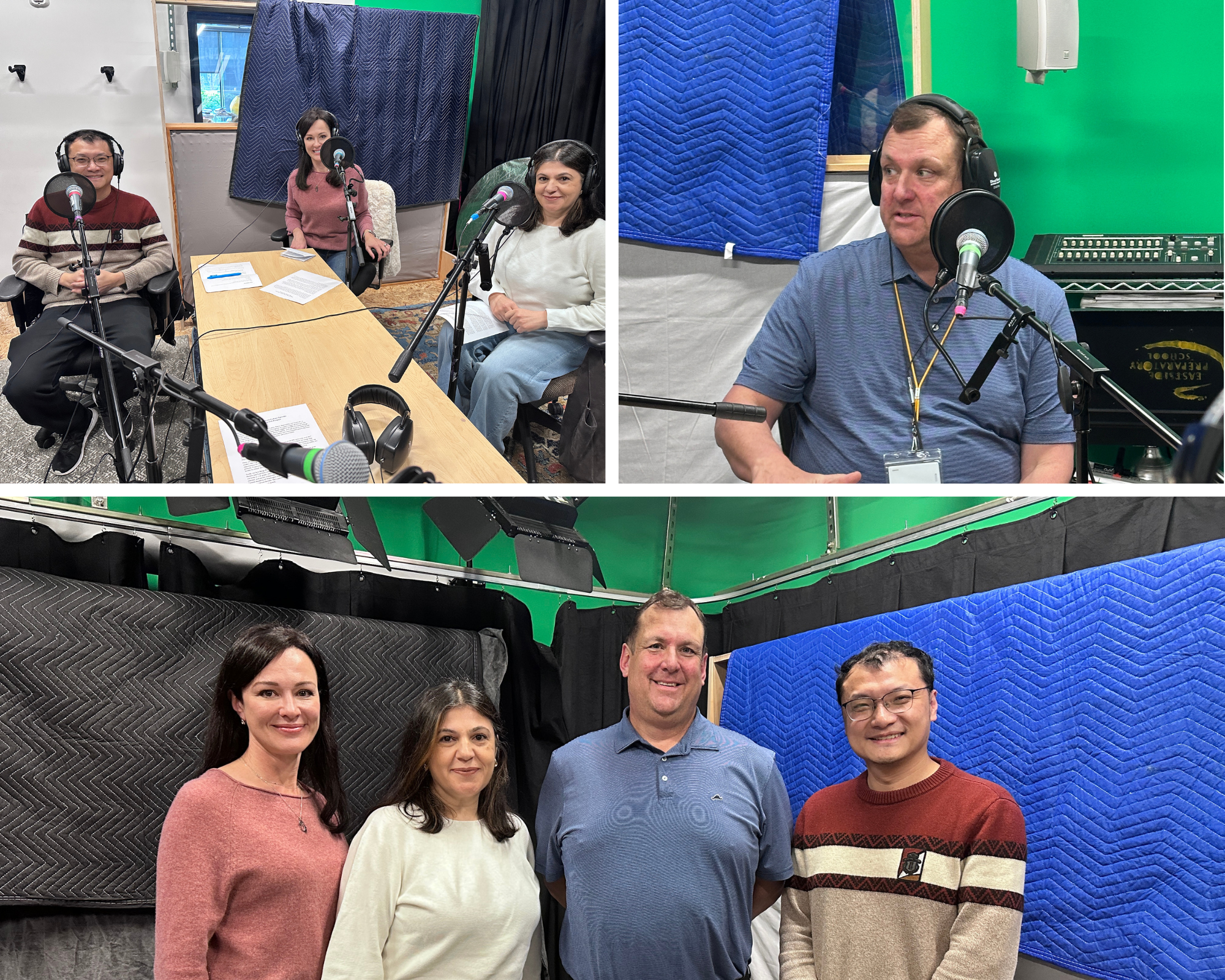
Joining us for today's episode are three guests who each bring a unique lens to the conversation around digital life and responsibility.
Dr. Habibar serves on the Eastside Prep Board of Trustees and the Health and Safety Committee, advising on policies related to communication, wellness, and risk. As a radiologist, researcher, and EPS parent, he brings a broad perspective on community care and is especially passionate about creating safe, thoughtful digital environments for students.
Amy Sanchez is our school counselor and the sixth grade level coordinator. She supports students emotional wellness and helps them build healthy boundaries and habits on and offline. Her work gives her insight into how young people experience the digital world from the inside out.
Victoria is a 10th grader at Eastside Prep, an active member of the school's robotics team, and also the captain and founder of the Science Olympiad team at eps. She brings the student perspective to today's topic, navigating both digital communication and innovation in her daily life at eps.
Welcome, everyone.
[00:02:02] Speaker B: Hi there.
[00:02:02] Speaker C: Hey, thanks for having me. Hi.
[00:02:05] Speaker A: First question, and this is for everyone.
If your digital life had a subtitle, what would it be?
[00:02:13] Speaker C: I work from my computer so much, it's Operation Inbox Zero.
I got to get to zero on that little red icon that you have on your inbox. The counter one. The other subtitle might be Marie Kondo's Clutter Desktop Nightmare. Because I'm so bad at getting rid of digital files, I just, you know, I hold on to them and I just think, oh, I might need that someday. So those would be my two themes.
[00:02:37] Speaker D: I would say mine is probably more generic, chronically connected. Because I'm always using some kind of technology, whether checking my texts or social media on my phone or even doing homework, it's always on my computer.
[00:02:50] Speaker B: I think mine would be my algorithm is all running or parenting. That's it. They send a lot of content my way in those two categories.
[00:03:00] Speaker A: Yeah, I've been thinking about mine, and I'm pretty sure it's cannot find the file I need. Victoria, what is one app, site, or trend that students use all the time. But us adults always seem to get slightly wrong when we talk about it.
[00:03:16] Speaker D: Me personally, I really like Instagram. Adults usually think it's just like a place to post photos. Photos. But it's kind of an all in one app. You can message other people and, like watch reels. Obviously, the photos and the stories that you can see from other people and you can follow other people. So it's kind of like a versatile app, and it's not just like some random place where you can share photos.
[00:03:37] Speaker A: Amy, what kind of digital stress do you hear about most from students? Is it group chats? Is it social media? Is it deadlines? And when you hear this, how do you help kids navigate it?
[00:03:48] Speaker B: The way that I think about digital stress is that there's stress and the issues of adolescence and mental health challenges, and then they get carried over into the digital world and technology. So I think there are certain, you know, unique stresses that have to do with tech. But for the most part, in my work, counseling with students, stuff that would be present no matter what happens, to come out through a tech medium, a tale as old as time that middle school is all about thinking. How do I fit in with the group? Who am I with other people? Who are my friends, who are my enemies? How do I think about things myself? But now we have AI, we have teams chat, we have Instagram, we have Snapchat, and it all gets rolled out sort of at different ages, too. It's a lot of that social piece is what I'm working through.
[00:04:38] Speaker A: When I was in school, whatever the swirl of school was, you could leave it there and then you went home, and then you went back to school and encountered it. But now those boundaries are much more porous, I think.
[00:04:49] Speaker B: Certainly counseling doesn't work well if I'm always making comparisons to my own middle school experiences, but I totally draw on it myself, too. And I'm somewhat in the middle, so I'm a millennial. And when I was in middle school, I got Facebook in 8th grade and we had AOL instant messenger, which in many ways is similar to teams Chat, much less sophisticated, but it's kind of like a similar mechanism. So in some ways I understand that experience because I think I was part of the first generation to really live my social life partly online and in person in the school day. But then at the same time, tech has evolved so much since when I was there myself.
[00:05:27] Speaker A: So, Habib, from your vantage point, how has the conversation around digital responsibility shifted for families in Recent years. And what's one thing we could all be talking way more openly about?
[00:05:39] Speaker C: This is something I've been reflecting a little bit about. And I started reading this book that Sarah Peden recommended called Growing up in Public. And it got me thinking a lot about how things have changed over time. So when, you know, my oldest, Nima, was born and he was just a little squirt and he was like, as he got older to like three or four, I remember his mom and I just being so amazed by how easy it was for him to open an iPad and just access it. And then the pediatricians and everyone was telling us, screen time is bad, you gotta limit it. It's about limiting screen time, putting barriers, and keeping kids from hurting their brains from, you know, not developing the way it should.
As time evolved and things moved on and his. He got older and evolution of technology happened, it became more about safety, more about, like, okay, well, where can you get yourself into trouble? We still want to restrict it, but now we're going to, like, monitor you a little bit more. We're going to put restrictions on. We're going to say, okay, you can access this site, but, you know, you can't access that site. And it never really worked. And what I was so impressed about with EPS when we first started was we had some series about digital responsibility.
The mantra was always like, let's just teach them how to engage with this. Let's not put barriers and let's not tell kids that they can't use their computers and they can't access sites, but let's teach them responsibility. And I think that's the conversation that we're moving more and more to. Because AI has become ubiquitous, digital platforms are all over the place. There's really no way to fully limit these things. And they're part of our lives. We have to engage with them. And so I think the conversation, conversation now is about how do we do this responsibly, how do we do it with integrity, how do we keep each other safe? And then how do we recover from our mistakes? Because we're going to make those digital mistakes. And I think that's the piece that we probably aren't talking about enough. It's okay to make some digital mistakes. We want to limit the severity of them, but you will recover and you'll learn from it. And there is life after a really big, you know, Instagram snafu.
[00:07:38] Speaker A: So this one's for everyone. It builds on exactly what you were just saying. Because we do say the Internet, never forgets which may have that unintended consequence of thinking that you can't ever recover from an online mistake. What I wonder is, do most people actually think about that before they post or hit send? You know, how can we make pausing before posting an actual habit?
[00:08:03] Speaker D: Victoria I think we learned in middle school there was like a strategy to think, would you say this to your grandma or something?
Because when you're talking in person, you're not separated by a screen. You can see the other person's expression and you're less likely to say something hurtful if you're posting something. Showing a picture to a friend, it would be almost a little bit different than if you're like posting online. Kind of like the grandma technique.
[00:08:27] Speaker B: So I'm the sixth grade grade level coordinator and we do a lot of work in our middle band around lots of different socio emotional learning content. One of a big one is digital wellness. And we just did that lesson a couple of weeks ago where we talk about the grandma rule and kids were talking about whose grandmas might be the most offended by certain things.
So I think that's a memorable piece. But what's also true is that impulse control is a skill that's in development, honestly, forever. You know, we can't expect middle schoolers and high schoolers to be the most expert in impulse control. I mean, even myself, there's certainly times where I hit send on a message too fast. It could be a professional email or it could be kind of a judgmental comment. I think we need to normalize that. This is something that happens to all of us, but it also is a behavior that's workable. And by processing the situation and sort of slowing down the thinking, even if it's after the fact, that's how we can learn how to do it differently next time. In sixth grade too, I tell this exceptionally embarrassing story of myself when I messed up in a digital experience where I sent a message to a group chat, intending to exclude a person from the group chat, but actually including that person on the group chat. This is when I was in college and we workshop that together. And it's again, profoundly embarrassing for me but also really helpful for kids to see. Like we all do this and let's talk about what Ms. Sanchez should have done differently. And hopefully there's carryovers to them.
[00:09:52] Speaker C: In my work, I do a lot of emails, a few rules, and I try to follow them. Sometimes I don't always follow them, but the first rule is if I find myself writing more than a few paragraphs, I should probably walk away, probably going to be perceived as speaking to them in sort of a lecture manner. And the tone isn't really going to land well. And could this all be achieved better by just talking to the human being in person? And then the second one is, think I'm reading a tone of an email negatively. Maybe I should just ask them what their tone really was instead of assuming what it is. And you can do that in person or you can just say, hey, I read this. I know it's dangerous to read tone. That's how I read it. What did you really mean? Really want to hide behind these digital screens so often, but we miss so much because of that and just call it out.
[00:10:37] Speaker A: I hear a really important caution in these responses, which is this is not a kid thing. This is not a kid problem. This is a human challenge that doesn't matter how old you are or when the technology arrived. This is something that we can be in dialogue about together.
[00:10:53] Speaker B: What I hear from kids sometimes too, when talking about digital boundaries, they say, well, my parents screen time is off the rails. I think we have to meet kids where they're at too and say that. Because if we come down on the kids, it's like you're doing all these bad things. Your generation has all these trouble.
Who's gonna want to listen to that?
[00:11:10] Speaker A: You know, I've been chirping at my kids a little bit more recently about screen time.
But what I realized is that as I'm doing that, I'm watching tv.
My screen at our house is the tv. And if I'm binging on alone four hours in a row. But meanwhile the kids are hanging out with me and I'm chirping cause they're on their devices. I'm still trying to figure this one out.
[00:11:30] Speaker C: I think the hardest thing as a parent is to try to meet them with curiosity about what they're doing. Because I just find it so confusing.
Yeah, like I like, why is this interesting to you? But I think that's a key thing for us. If we really want to engage with them, we have to meet them where they're at. And that's on those devices in those certain types of platforms.
[00:11:48] Speaker A: So, Victoria, have you ever felt misunderstood online? Something you posted came across the wrong way. Did it teach you any lessons about clarity and tone in the moment?
[00:11:57] Speaker D: We've all had some kind of experience like that. I don't remember a specific instance, but I have remember like sending a message in a group chat. And I was trying to be like sarcastic and funny. My Friends thought it was supposed to be slightly more mean than it intended to be in person. If I said it out loud in a sarcastic, funny tone, they would have understood and laughed for everyone.
[00:12:17] Speaker A: AI tools like ChatGPT and image generators and filters really are everywhere now. They're ubiquitous. So what does digital responsibility look like when a machine can do your homework or write your texts? And this one, I gotta be honest, worries me a lot. Fake someone's voice.
[00:12:34] Speaker C: I think EPS is so well positioned for this question because somehow when you guys all thought about the tally mantra, it seems to really transcend all of these different things that happen. And we got to focus on critical thinking more than ever. How do we understand what is real and what's not? What are the limitations to AI and where are the barriers? And where are we adding value? Where can AI not fit in terms of can actually produce results that we need so we can best understand our true value as human beings and humanity? I think it's also just a chance to double down on intellectual integrity and understanding. Hey, it's more about the process and developing something rather than the product and the efficiency around it. Because AI is going to make us all more efficient, but how are we all going to learn to be better human beings through that? And so those are the two areas that I think we can focus on. And I love how EPS has kind of always been focusing on those things.
[00:13:24] Speaker B: Again, I think same issues tale as old as time, but with this technology piece added to it. There have always been ways to cheat on something or do something the short way or lie about the effort that you put in to something. And now we've been juggling with bowling pins and now maybe the, the bowling pins are slipperier or I think it might be too aggressive to say the bowling pins are on fire. But we have strategies to work on how to teach kids to live and work with integrity. And now we're just applying it to the tech tools we have at our.
[00:14:00] Speaker D: EPS does a good job teaching US to use AI. When ChatGPT was first like becoming popular, I was in, I don't know us sometime in middle school. I remember one of my teachers, Ms. Hale, she showed us there's this thing called ChatGPT. Here's how you can use it. And this is an example of an essay written by ChatGPT for our current topic was resistance in the Japanese incarceration, which is a very heavy topic. And then she explained to us that yes, this can be more efficient and yes, this can be helpful especially for research. It's not all bad. However, this essay is filled with buzzwords and no true point behind it. And that is usually what comes from humans. So when we're doing homework or writing an essay or doing a project, we should all take a moment to think. If I made this using AI, would it really represent a contribution to the actual question, or would it just be a regurgitation of what all the information that this AI was trained on.
[00:14:57] Speaker A: Fascinating. What's old is new again, engaging with the same challenges and problems of humanity. And the technology's changed along the way, but the core of it, the center of it, is really the same.
[00:15:09] Speaker C: Yeah, we're just in lightning speed right now, though. That's the hard part. And it changes so fast. And I think it puts adults really off guard and they don't know exactly how to engage with it. But no one's ever done well by just putting their head in the sand. We got to invest in it, meet the kids where they're at. And I love hearing your perspective because it's really cool to hear how you're embracing it and learning to use it in an ethical way and in a way that's valuable.
[00:15:32] Speaker B: That's a great point. My kids are young. They're one in four. What you said earlier really spoke to me about how quickly kids can learn tech tools. Once you reach a certain age, it gets a little harder to learn new things. You certainly still can. But it's incredible to see how quickly kids are able to learn. But that's intimidating for me as a parent when I'm thinking about how quickly my 1 and 4 year old are able to pick up on things. And I want to make sure I fully understand what they're understanding. But at the same time, you can't keep pace with them as well. And then you think too well, where do I go to be able to learn enough about what my kids are doing? What are my resources at my disposal? Cause I can't spend all day trying to learn about their world, Right?
[00:16:12] Speaker A: Trying to figure it out.
Amy how can students set digital boundaries that are actually doable? And how can adults model healthy tech youth without just saying, turn it off?
[00:16:24] Speaker B: The work that I do in counseling, it kind of comes down to developing insight and problem solving. And we're using those skills for digital conversations too. And so one is, you know, do they know what the problems actually are? Do they believe that there are problems? Do they have an interest in solving some of those problems? Because if the willingness and the interest isn't there, you're Only going to get so far. You got to have stake in the game for making some sort of a change. Parents or adults might have different opinions about the intensity of the need for the change or what the problem is, but that can all be workshop. And then the second piece is problem solving. You have to set reasonable goals. They have to be small enough to develop some confidence around. And then when you start to build little habits, then they can turn into bigger habits. You know, like for me, when I first started being like, I really need to get better at flossing, I didn't say, well, I have to floss every day for the rest of my life. I mean, I've been, it's true. But also, if you make a goal that big, you're gonna feel like you're gonna fail at it. But if you start small and build, then it's more possible.
[00:17:31] Speaker A: So let's conclude today by providing listener with one small action that everyone can take students, adults, or schools to make digital spaces feel a little safer, a little clearer, and more caring. This year I just go back to.
[00:17:45] Speaker C: My childhood days and think about, look both ways before you cross the road. Just pause, think about the person to your left or your right in the digital space before you post and ask yourself, is this a kind thing? Is this something I'd say to the person in real life? I think that would go far, a long way to make things a little safer and happier.
[00:18:03] Speaker D: As a chronically connected person, sometimes it's okay to step back a little, go out, take a walk in nature, and completely disconnect from everything. And maybe that assignment that you were Planning to use ChatGPT for, maybe you would think about what are some of your original ideas that don't have to be completely fleshed out and then come back from that walk and write them down. That little disconnect once in a while will help you be more centered as a student and a person and have a healthier digital life.
[00:18:31] Speaker B: For me, I try to connect to some of the feeling behind the digital behaviors that you have. I mean, it's easy to numb out with technology, but sometimes if we're using tech to procrastinate, well, maybe there is a feeling of guilt or sadness or anger that we're not actually feeling and probably not going to be resolved until we feel that feeling and do something with it. I know it's cheesy to have the counselor say, you got to feel your feelings, but you kind of do got to feel.
[00:18:58] Speaker A: You kind of do. No, it's really true.
[00:19:00] Speaker B: And tech can be really good at masking what we actually need to do to process feeling a problem and get to a solution that will help our well being.
[00:19:09] Speaker A: What a conversation and obviously we're going to keep having it because the pace of change with AI is really like nothing humanity has seen and I think that is its own challenge within the challenge of evolving technologies and learning how to use them and learning the manners with these technologies. So thank you so much. What a conversation.
[00:19:27] Speaker D: Thank you, thank you.
[00:19:28] Speaker C: That was a lot of fun.
[00:19:29] Speaker A: Huge thanks to our guests for sharing honest thoughts, stories and ideas on what it means to be digitally responsible in today's world. This conversation reminds us that clarity isn't just about being understood, it's also about being intentional, thoughtful and kind in the digital spaces. All share thanks for listening to insightful questions and we'll see you next time for more insights. Be sure to check out the EPS Weekly News every Friday.